
 New Horizons
 Project Management Academy
 Six Sigma Online
 TCM Security
 TRACOM
 Velopi
 Watermark Learning
 Login
Login


Secure Your Network and Protect Your Business
Loading form...
Ready to see how your external defenses hold up against real-world attacks? Fill out the form to connect with our experts. After a quick intro call, you will have a tailored quote within 48 hours.
More Penetration Testing Services
- External Penetration Testing
- Internal Penetration Testing
- Physical Penetration Testing
- Social Engineering
- Vulnerability Scanning
- Web Application Penetration Testing
- Wireless Penetration Testing
An external network penetration test simulates a real-world attack against an organization’s internet-facing systems and infrastructure. It evaluates how effectively perimeter defenses such as firewalls, VPNs, web services, and exposed hosts protect against unauthorized access. By identifying vulnerabilities, misconfigurations, and exploitable weaknesses visible to an outside attacker, an external penetration test helps reduce the risk of breaches before adversaries can gain an initial foothold.
Learn More
An internal penetration test simulates a real-world attack from inside an organization’s network to evaluate the strength of its defenses. It assumes an attacker has already gained limited access to the network through a compromised user account or workstation and tests how effectively network controls prevent lateral movement, privilege escalation, and access to critical systems. The goal is to identify weaknesses in network design, configurations, and permissions before they can be exploited in a real attack.
Learn More
A physical penetration test evaluates an organization’s ability to prevent unauthorized physical access to its facilities, systems, and sensitive assets. It simulates real-world intrusion attempts including tailgating, badge misuse, or bypassing physical controls to identify weaknesses in locks, access controls, surveillance, and security procedures. By uncovering gaps in physical security, a physical penetration test helps ensure that facilities, personnel, and critical infrastructure are protected against threats that could bypass technical defenses entirely.
Learn More
A social engineering engagement evaluates how effectively an organization’s people and processes resist manipulation by attackers. It simulates real-world social engineering tactics including phishing, pretexting, and impersonation to identify weaknesses in awareness, training, and verification procedures. By testing how employees respond to these scenarios, a social engineering engagement helps organizations strengthen human defenses, reduce the risk of credential theft or unauthorized access, and reinforce security as a shared responsibility across the organization.
Learn More
Vulnerability scanning uses automated tools to identify known vulnerabilities, misconfigurations, and outdated software across an organization’s systems, networks, and applications. It provides a broad, repeatable view of security weaknesses by continuously checking assets against up-to-date threat intelligence and vulnerability databases. While vulnerability scanning does not attempt exploitation, it plays a critical role in maintaining security hygiene by helping organizations quickly identify, prioritize, and remediate issues before they can be exploited by attackers.
Learn More
A web application penetration test evaluates the resilience of a web application against real-world attacks. It focuses on identifying vulnerabilities in application logic, authentication, authorization, input handling, and session management by simulating how an attacker would attempt to exploit the application. By uncovering issues such as injection flaws, broken access controls, and insecure configurations, a web application penetration test helps ensure your application protects user data, enforces proper access, and supports a strong overall security posture.
Learn More
A wireless network penetration test evaluates the strength of an organization’s Wi‑Fi and wireless infrastructure against real-world attacks. It focuses on identifying weaknesses in wireless configurations, encryption, authentication, and device management by simulating how an attacker could gain unauthorized access to the network. By uncovering issues such as weak passwords, insecure protocols, rogue access points, and improper segmentation, a wireless penetration test helps ensure your wireless network does not become an easy entry point into your environment.
Learn More
Our Approach
We go beyond automated scans and generic reports. With roots in education and hands-on training, our external penetration testing engagements are designed to help your team understand not just what we find, but why it matters and how to fix it.
From day one, you’ll have direct access to our testers through a dedicated communication channel, where we provide ongoing updates and context around our findings. We also offer the option for your team to shadow our testers, giving firsthand insight into real-world adversary techniques and practical ways to strengthen defenses.
Activities performed during external penetration testing include, but are not limited to:
● Vulnerability scanning and exploitation
● Social media intelligence gathering
● Username and account enumeration
● Breached credential intelligence gathering
● Service, port, and website enumeration
● Enumerating third parties for data leaks (S3 buckets, GitHub, etc.)
● Attacking login portals (Website, O365, VPN, etc.)
● Multi-Factor Authentication (MFA) bypassing
● Other testing depending on specific customer content and footprint
At the conclusion of the engagement, you’ll receive a detailed report that clearly prioritizes security issues by risk level to support efficient remediation. We offer retesting to validate that fixes have been successfully implemented, and our reports also highlight areas where your security controls are performing well – giving technical teams, managers, and executives a balanced, actionable view of your security posture.
Our Methodology
All testing performed is based on the NIST SP 800-115 Technical Guide to Information Security Testing and Assessment, OWASP Testing Guide (v4), and customized testing frameworks.
Our penetration testing process includes the following steps:
Plan
Customer goals are gathered and clear rules of engagement are established to guide the engagement.
Discover
Perform scanning and enumeration to identify potential vulnerabilities, weak areas, and exploits within the environment.
Attack
Confirm potential vulnerabilities through exploitation and perform additional discovery upon new access.
Report
Document identified vulnerabilities, exploits, failed attempts, and key security strengths and weaknesses.
By the Numbers
Key Statistics
%
of all data breaches were caused by external actors
Verizon 2025 Data Breach Investigations Report
%
of breaches were motivated by financial gain
Verizon 2025 Data Breach Investigations Report
%
of initial attacks utilized phishing
IBM Cost of a Data Breach Report 2025
%
of identity attacks are password spraying or brute force attempts
Microsoft Digital Defense Report 2025
Why Network Security Matters
Network security at the perimeter sets the tone for your entire cybersecurity posture. Internet-facing systems are constantly targeted, and a single exposed weakness can undermine otherwise strong internal controls. An external penetration test assesses how well your network architecture, access controls, and defensive technologies protect critical entry points from unauthorized access. By validating the effectiveness of your perimeter defenses and identifying gaps in network design or configuration, external penetration testing helps ensure your network enforces strong boundaries, limits attacker access from the outset, and supports a resilient, defense-in-depth security strategy.

Frequently Asked Questions
External Penetration Testing
How is an external penetration test different from an internal penetration test?
An external pentest targets internet-facing systems to see what an attacker could access from outside your network, while internal tests focus on threats within the network.
What risks does an external pentest uncover that scans don’t?
External pentests identify exploitable vulnerabilities, misconfigurations, and attack paths that automated scans may miss, showing how attackers could gain unauthorized access.
What techniques are used during an external pentest?
Techniques include network scanning and manual testing, exploitation of vulnerabilities, misconfiguration checks, password attacks, and OSINT/social engineering when in scope.
Do we need external pentests for compliance (SOC 2, ISO 27001, PCI, HIPAA)?
Yes, many compliance frameworks require or recommend testing internet-facing systems to verify security controls and reduce exposure.
How long does an external pentest take?
Typical engagements last 1–3 weeks, depending on the number of targets and complexity of your internet-facing environment.
Do you retest after fixes are applied?
Yes, we offer retesting to confirm that vulnerabilities have been successfully remediated.
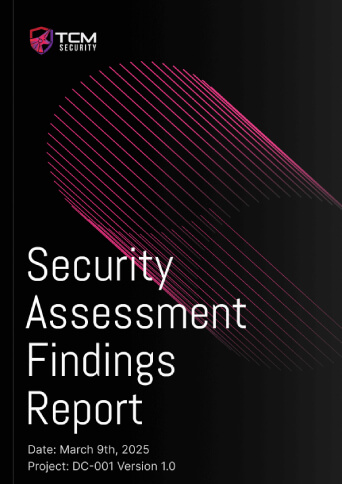
Inside a Real Pentest Report
A Report That Fortune 500 Companies Trust
Get a firsthand look at a real penetration testing report and understand how our expert team communicates risk, impact, and remediation steps.
Loading form...