
 New Horizons
 Project Management Academy
 Six Sigma Online
 TCM Security
 TRACOM
 Velopi
 Watermark Learning
 Login


Key Takeaways
- The short answer: yes, for IT professionals aiming at penetration testing work
- What it proves: you can run an engagement from OSINT to report and live debrief
- What it costs: $499 for the voucher, a free retake, and 12 months of training
- Where it leads: pentest roles, where U.S. penetration tester pay averages about $89,000 to $106,000 depending on the source
- When to wait: newer testers start with the PJPT, the first step on the same path
The PNPT (Practical Network Penetration Tester) is a hands-on certification from TCM Security for people who want to work in penetration testing. Search for it online and the same two topics keep coming up: how realistic the exam is, and how much weight employers give it next to other penetration testing certifications such as the OSCP.
The exam is simple to describe. It asks you to do the job of an ethical hacker: you attack a simulated company network, write the report a client would receive, and present your findings in a live debrief. Passing shows you can do the work, which is what job-ready means for a pentester.
Then there is the question of how employers see it. To help you weigh that, this guide covers the jobs the PNPT points toward and who is ready for it now versus who should start with our entry-level PJPT.
Is the PNPT Worth It?
Yes. The PNPT is worth it if you have working IT fundamentals and want a pentest role, because the exam makes you produce what the job produces: a compromised network, a professional report, and a debrief. With training and a free retake included, and a certification that never expires once you earn it (the exam voucher and training access do), it’s a low-risk way to prove practical skill.
That yes applies to you if you meet three conditions.
- You’re comfortable on Windows and Linux and understand how networks fit together.
- You’re ready to work through Active Directory attacks, since the exam ends at the Domain Controller.
- You want offensive security work, with a pentest role as the goal.
Before you buy, check whether the job postings you want name the CEH or OSCP first. If they do, the PNPT still gives you plenty to talk about in an interview, because the exam leaves you with the experience of a full engagement.
If you can’t check all three boxes yet, start with the Practical Junior Penetration Tester (PJPT). Next comes what an employer sees if you pass the PNPT.
What the PNPT Certification Proves to Employers
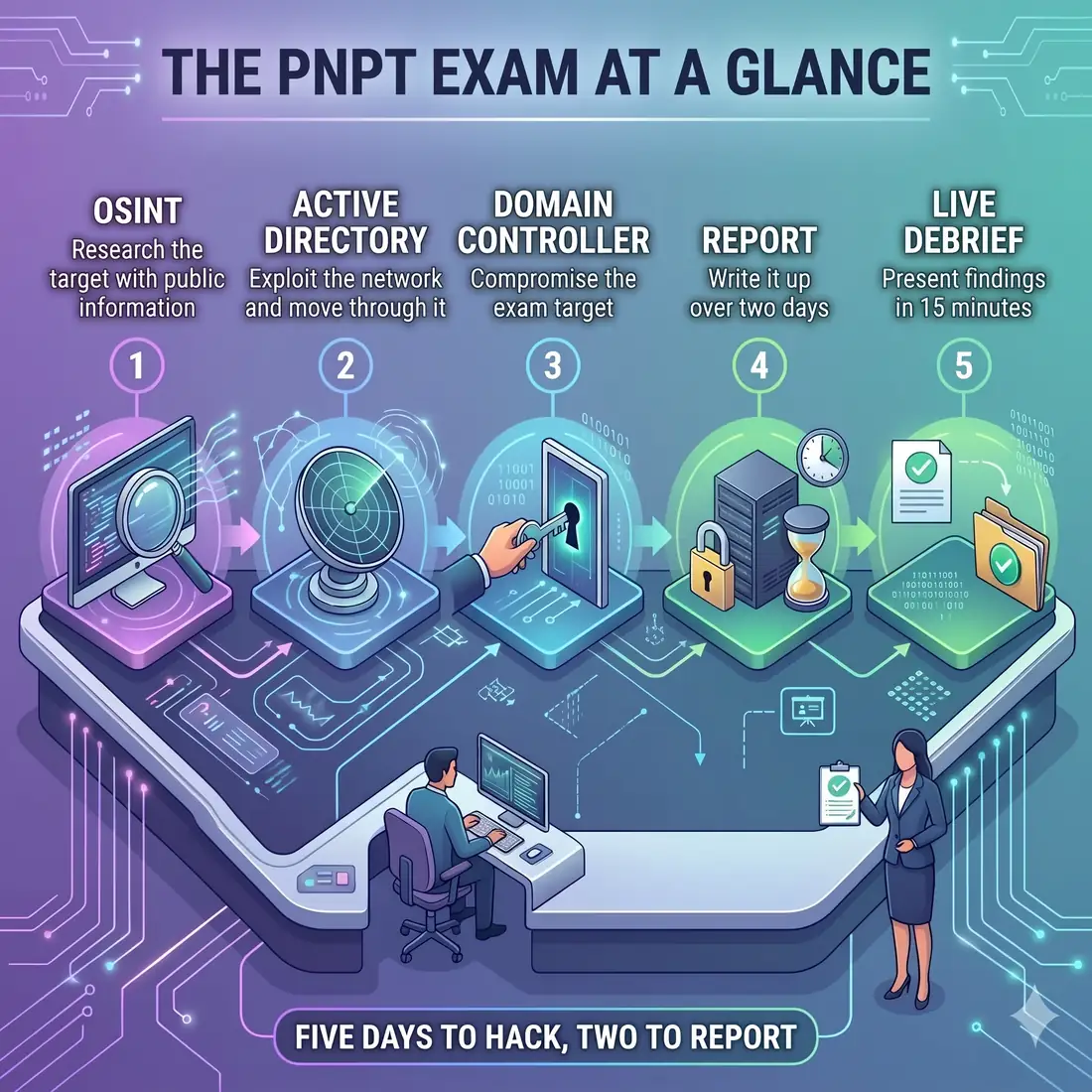
In ISACA’s 2025 State of Cybersecurity survey, employers ranked prior cybersecurity experience second only to adaptability when judging candidates. The PNPT is a way to show you have it. You get five days to attack a simulated network, two more to write the report, and then you explain your findings in a live debrief. Finding weak spots and communicating what you found are core tasks of the penetration tester role. There’s no multiple choice on this exam. You pass by doing the work.
In an interview, you can talk through a full engagement from your own experience. Pick the finding you’re proudest of and tell it as a story: how you spotted it, how you got in, and what you told the client to fix. You did every step yourself, so you can handle follow-up questions in detail.
The Five-Day Engagement, Report, and Live Debrief
That hands-on work is what the whole exam is built around. You research the target with open-source intelligence (OSINT), exploit Active Directory, move through the network, and finish by compromising the exam Domain Controller. Then you present your report in a live 15-minute debrief.
Many organizations screen candidates the same way. In ISC2’s 2025 hiring study, 84% said they use skills-based assessments or tests for entry- and junior-level applicants. The PNPT puts you through a hands-on assessment of your own. For a step-by-step account of the exam, read The PNPT: Pentest Experience Certification.
What Changed in 2026: AI Tools on TCM Exams
The exam has one recent update to the rules. In May 2026, we published our policy on AI tools for certification exams. On the PNPT, all tools are allowed, AI-enabled ones included, as long as you explain in your report how you used them. Two limits apply: AI can’t stand in for your own technical understanding, and help from another person is still banned.
AI skills are also in demand across the field. In ISC2’s 2025 Cybersecurity Workforce Study, AI was the most pressing skills need, cited by 41% of respondents. On the PNPT, you can use AI tools during a full engagement and then document that use in your report, so you get practice at the exact thing our AI tools policy asks for.
PNPT Jobs: Roles the Certification Prepares You For
The PNPT prepares you for jobs including penetration tester, network pentester, and red team operator. Each one leans on a different part of the exam.
Penetration Tester
A penetration tester attacks a company’s systems on purpose, using simulated internal and external cyberattacks, to find out how secure they are. The other half of the job is writing up what you found, with a report that recommends fixes. The PNPT covers both halves: you attack a network, then write the report a client would get. It’s a hard exam, even for junior pentesters, so passing is a good sign you can handle the core of the role.
Network Pentester
On a network pentest, you run simulated attacks on a company’s network to find its weak spots. On the PNPT, the internal part of that work is the Active Directory stretch, where you exploit Active Directory, then move sideways and upward through the network until you compromise the exam Domain Controller.
Those weak spots matter. Verizon’s 2026 Data Breach Investigations Report found that 31% of breaches now start with software vulnerabilities, ahead of stolen passwords as attackers’ top way in. Finding them before an attacker does is the point of the job.
Red Team Operator
Red team operator is one of the jobs the PNPT can help prepare you for. On the exam, you work from the attacker’s side. You research the target with open-source intelligence (OSINT) to plan your attack, then exploit Active Directory as you move through the network. By the end, you’ve planned an attack from public information and carried it through to the exam Domain Controller.
Adjacent Roles Where the PNPT Helps
The skills you use on the PNPT also fit two related jobs: security consultant and system vulnerability analyst. O*NET lists both as job titles for penetration testers. The NICE Workforce Framework describes vulnerability analysis as finding weaknesses, recommending fixes, and preparing audit reports, and it includes authorized penetration testing in that work. The PNPT has you practice that same mix, from the attack to the report.
In the UK, plenty of businesses lack that skill set: a 2025 government study found that about 30% had gaps in advanced skills, including penetration testing. So the attack and report work you practice for the exam can carry you past a single job title.
PNPT Salary: What Penetration Testers Earn
Penetration testers in the U.S. earn about $89,000 to $106,000 a year on average, depending on the source. That’s the pay for the role the PNPT prepares you for.
In Payscale’s numbers, pay grows quickly with experience. Pentesters with under a year of experience average $72,823 in total pay. With one to four years, the average is $96,429, about $24,000 more. The whole field is growing too, with the U.S. Bureau of Labor Statistics (BLS) projecting 21 percent job growth for information security analysts from 2025 to 2035, which it calls much faster than average.
The sources measure pay in different ways, which is why the averages differ. Payscale uses 287 salary profiles that workers reported themselves. Salary.com uses employer job postings and other data. The closest BLS category is information security analysts, so the table includes it too.
| Measure | Payscale, pentesters | Salary.com, pentesters | BLS, information security analysts |
|---|---|---|---|
| Based on | 287 worker-reported profiles, updated July 2026 | Employer job postings and other data, as of October 2026 | U.S. government wage data, May 2025 |
| Low end (10th percentile) | About $69,000 | $73,025 | Under $75,090 |
| Typical | $106,261 average | $88,568 average | $129,180 median |
| High end (90th percentile) | About $154,000 | $100,576 | Over $199,850 |
Experience is what moves those numbers, and the PNPT adds a full engagement to yours. That gives you something concrete to bring to a pay conversation. None of these sources breaks out pay by certification, so use the figures as the range for the role.
How to Use the PNPT in a Job Interview
If you’re changing careers, expect the interviewer to ask what makes you ready for a pentest role. Show them your body of work. Pick two or three things you’ve done. They can come from your past IT work, your lab practice, or your PNPT engagement. For each one, be ready to explain the problem, what you did, and what came of it.
Specific examples are easier to follow than a list of skills, and they work whatever your past job title was. When pay comes up, use the figures above to come in with a range, and aim for the part that matches your experience.
PNPT Cost, Time, and What the Voucher Includes
The PNPT costs $499, and that covers the exam and the training that goes with it. You buy it on our certifications site, which is separate from the Academy subscription. The training that comes with it is delivered through the Academy, the same platform subscribers use.
Here’s what the $499 includes, plus the retake fee and discount that can apply:
- Exam voucher: one PNPT attempt plus one free retake
- Training: 12 months of access to 45+ hours of on-demand video
- Voucher window: valid for 12 months from purchase
- Paid retake: $100 if you need a third attempt
- Discount: 20% for current and former military, first responders, students, and educators
The free retake matters most. If your first attempt falls short, your second one is already paid for. If you start with the PJPT instead, its voucher is $249 and a paid retake is $100.
PNPT Prep Time: Hours of Training and Study
How long you’ll need depends on what you already know. The PNPT voucher gives you 45+ hours of training and 12 months to use it. That training is five courses: Practical Ethical Hacking, Windows Privilege Escalation, Linux Privilege Escalation, OSINT Fundamentals, and the External Pentest Playbook. Plan to spend some of those 12 months on lab practice, too.
Can Your Employer Pay for the PNPT?
If your employer runs a qualifying educational assistance program, it may cover the cost tax-free. IRS Publication 15-B (2026) states that employers can exclude up to $5,250 a year of educational assistance from an employee’s wages. Ask HR whether your company has one before you pay out of pocket. This is general information, not tax advice.
Benefits of the PNPT Certification
When you pass the PNPT, you come away with a full penetration test report written to a professional standard. You also get practice presenting your findings in a live debrief.
Why the Report and Debrief Matter on the Job
OWASP’s Web Security Testing Guide counts the technical work as only half of an assessment and treats the report as the final product, written for executives and technical staff. The UK’s National Cyber Security Centre says the report should rate “the level of risk that each vulnerability exposes” and give “a method of resolving each issue found.” It also says a debrief, where the testers run through their findings, can be useful.
Communication is the skill behind both. In ISC2’s 2025 Workforce Study, professionals ranked communication the top in-demand skill at 59%, and hiring managers ranked it third at 48%. So the people doing the work rate communication higher than the people hiring for it.
A 2025 IEEE Access study of 25 focus-group participants found that report content has to match its readers’ needs. The PNPT tests communication twice, once in the written report and once in the live debrief.
How the Industry Views the PNPT vs OSCP, CEH, and eJPT
Each of these exams tests something different. The PNPT has you work a full engagement over five days, write the report, and defend it in a live debrief. The OSCP is a 24-hour exam followed by a written report. The CEH is a 125-question multiple-choice exam, and the eJPT is a hands-on, entry-level exam that’s graded automatically.
Writing is a big part of the job, too. A 2025 study of penetration tester job postings in Australia, Canada, the UK, and the US ranked documentation among the top skills listed. On the PNPT, you write a professional report and explain it out loud in a live debrief, so you practice both.
What Each Exam Asks You to Produce
The table lists what each issuer states on its own pages, checked October 2026.
| Credential | What the exam asks you to produce | Validity, as stated by the issuer |
|---|---|---|
| PNPT (TCM Security) | A five-day external-to-internal engagement, a professional report written over two more days, and a live 15-minute debrief | Does not expire |
| OSCP (OffSec) | A 24-hour proctored exam across standalone and Active Directory machines, then a report submitted within 24 hours | OSCP does not expire; OSCP+ expires after three years |
| CEH (EC-Council) | A 4-hour, 125-question multiple-choice exam, with an optional 6-hour practical of 20 challenges | Three years, renewed with 120 credits and an annual fee |
| eJPT (INE) | A hands-on, entry-level exam with automated grading | Three years |
| CPTS (Hack The Box) | A 10-day lab and a commercial-grade report, with no multiple-choice questions | No expiration, per Hack The Box at launch |
| PenTest+ (CompTIA) | Up to 90 multiple-choice and performance-based questions in 165 minutes | Three years, renewed with 60 CEUs |
Our exam ends with a live debrief, the part closest to a client meeting.
Where the PNPT Fits on a Certification Path
We place the PNPT as the capstone of our Enterprise Penetration Testing learning path, with the PJPT before it. If the job postings you want name the OSCP, the PNPT builds network and Active Directory skills the OSCP also tests, since the OSCP exam includes an Active Directory set. If you already hold the OSCP, the PNPT’s live debrief adds the spoken, client-facing part of the work.
Who the PNPT Is For, and When to Start With the PJPT
Where you start depends on the experience you already have. The PNPT is a professional-level exam and the last step on our pentesting path. If you have professional hacking experience, you can go straight to it. If you don’t, we recommend starting with the PJPT, which leads right into it.
Signs You Are Ready for the PNPT
You’re likely ready if you’ve practiced Active Directory exploitation in a lab. If you already work as a mid- or senior-level pentester, you should get through the exam without much trouble. We expect it to be challenging for junior pentesters and moderately difficult for candidates with no professional experience.
When the PJPT Is the Better First Step
Start with the PJPT if pentesting is new to you. We built it as an associate-level introduction that requires no prior penetration testing experience. It gives you two days to hack and two more to write the report, and doesn’t expire. You need one course for it, Practical Ethical Hacking, where the PNPT needs five.
In ISC2’s 2025 hiring study, 89% of hiring managers said they would consider candidates whose only qualification is entry-level cybersecurity certifications, which is the category the PJPT falls in. If you pass the PJPT first, you’ll start the PNPT already used to our hack-then-report format. The TCM Pentester Certification Roadmap lays out the full sequence.
Is the PNPT Worth It for Your Career?
Yes. The PNPT asks you to do the real work, and experience is among the top things employers look for. When you pass, you leave with both the skills and a story you can tell in an interview.
If you’re moving into pentesting from another IT job, that matters. Changing paths can feel like starting over, and the PNPT lets you bring what you already know and add proof you can do the new work. If you checked all three boxes earlier, your next step is the PNPT certification from TCM Security. If you didn’t, start with the Practical Ethical Hacking course and the PJPT, and work your way up to it.
PNPT Certification FAQ
Does the PNPT certification expire?
No. Under our policy, the PNPT doesn’t expire.
How hard is the PNPT exam?
It depends on your experience. If you’re a beginner, it’s very difficult, and we strongly recommend finishing the included training first. Junior pentesters will find it difficult and may need extra training. Mid- and senior-level pentesters should find it moderately difficult. We don’t publish a pass rate.
How long does it take to finish the PNPT?
The exam takes up to seven days, five for testing and two for the report, followed by a 15-minute live debrief. Prep time depends on where you start, and the included training runs 45+ hours.
Is the PNPT good for beginners?
Beginners should start with the PJPT. The PNPT is a professional-level exam, so we recommend the PJPT first if you don’t have professional cybersecurity experience. It’s an associate-level certification and the first step on the same path, and it doesn’t require any previous experience.
Does the PNPT help you get a job?
It gives you real work to talk about in interviews. The PNPT prepares you for jobs like penetration tester, network pentester, and red team operator. If you pass, you’ve carried a full engagement from first research to final report. No certification guarantees a job offer, but we’re confident it will make a difference.
Can you use AI tools on the PNPT exam?
Yes. We allow all tools on the PNPT, including AI-enabled tools, as long as you disclose in your report how you used them.

About the Author: Megan Percy
Megan Percy is the Senior Product Manager at TCM Security, where she focuses on building impactful cybersecurity training. With a background spanning digital forensics and network security, she’s passionate about making complex ideas accessible through great storytelling. When she’s not shaping the future of the TCMS platform, you’ll find her reading, cooking, or playing Magic: The Gathering (Commander).
About TCM Security
TCM Security is a veteran-owned, cybersecurity services and education company founded in Charlotte, NC. Our services division has the mission of protecting people, sensitive data, and systems. With decades of combined experience, thousands of hours of practice, and core values from our time in service, we use our skill set to secure your environment. The TCM Security Academy is an educational platform dedicated to providing affordable, top-notch cybersecurity training to our individual students and corporate clients including both self-paced and instructor-led online courses as well as custom training solutions. We also provide several vendor-agnostic, practical hands-on certification exams to ensure proven job-ready skills to prospective employers.
Pentest Services: https://tcm-sec.com/our-services/
Follow Us: Email List | LinkedIn | YouTube | Twitter | Facebook | Instagram | TikTok
Contact Us: sales@tcm-sec.com
See How We Can Secure Your Assets
Let’s talk about how TCM Security can solve your cybersecurity needs. Give us a call, send us an e-mail, or fill out the contact form below to get started.